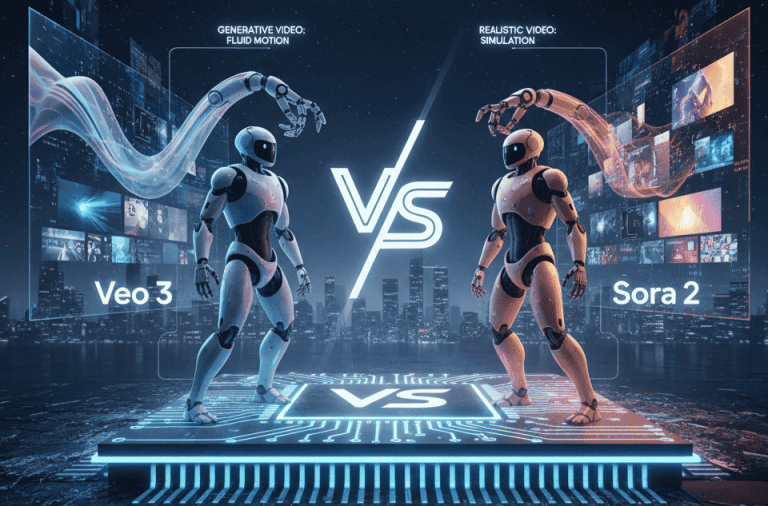

The race for AI video generation supremacy is now very intense. It is a huge, trillion-dollar battleground. This is much more than a simple test. The rivalry between Google Veo 3 and OpenAI Sora 2 defines the new generation of video AI. These new models easily beat older systems. So, knowing the main differences is key. This matters for all creative professionals or investors. They must predict where the industry is heading. This analysis compares Google’s cinematic realism to OpenAI’s focus on creative coherence.
The Core Battleground: Fidelity vs. Consistency
Veo 3 and Sora 2 have different main design goals. These goals show the best way to use each model. Google built Veo 3 to be a powerful tool for production. Its main strength is the best 4K resolution. It also has synchronized audio built-in. Sora 2 uses OpenAI’s transformer design. It focuses on better temporal and 3D consistency. Its video output is often limited to 1080p.
Also, Veo 3’s integrated audio is a big advantage. This audio includes dialogue, sound effects, and ambient noise. The sound is generated along with the visuals. This feature removes the need for extra sound work later. Sora 2 has greatly improved its spatial audio and lip-syncing. This is much better than its first version. But its audio still seems less smooth than Google’s single-render method.
Architectural Advantage: The Physics Engine
Good video generation needs more than just realistic pixels. It must have physically accurate motion. Because of this, Sora 2 claims a big advantage here. Its training seems to give it a better grasp of real-world physics. It understands momentum and how objects interact in longer videos. For example, previous AI models struggled with water behavior. They also struggled with disappearing objects. Sora 2 minimizes these physics errors. This lets it create complex, story-driven scenes up to 60 seconds long.
Veo 3 offers great detail and realism in short clips. But, it is mainly built for 8-second output. It uses powerful text prompts to keep complex 3D shapes stable during long camera moves. Therefore, Sora 2 is more stable for filmmakers who focus on complex character motion or long, dynamic sequences. Its underlying world model architecture provides this stability.
Speed, Scale, and the Professional Premium
Finally, the choice depends on your work speed and budget. For example, Sora 2 is often much faster. It renders videos 40% to 50% quicker than Veo 3 at the same quality. This speed is valuable for social media creators. It is also good for teams that need quick changes. They require fast, high-volume results.
Veo 3’s advantage is its professional integration. Indeed, its 4K output removes the need for expensive, time-consuming upscaling. This makes it the clear choice for broadcast and advertising. It is also great for high-end YouTube content.
Also, the availability models are very different. Sora 2 is easy to access. It uses the consumer ChatGPT Plus/Pro ecosystem. It includes social options like the “Cameos” function. This lets users integrate their own look. Veo 3 is part of the Google Cloud Vertex AI suite. This means its main users are enterprise developers and production studios. They need strong API access and cloud support for big projects.
The Verdict: Two Paths to AI Video Dominance
In conclusion, both Veo 3 and Sora 2 are revolutionary tools. But, their designs mean they target different parts of the market. Google Veo 3 is the best tool for high-fidelity, production-ready output. For this model, audio and final picture quality are essential. OpenAI Sora 2 leads the way in narrative coherence and quick changes. This defines the future of AI social content and internal planning.
Therefore, neither model is fully “superior.” Instead, they are perfect for different parts of the trillion-dollar video economy. The successful production house of the future will not choose one. Instead, they will use both models. This will maximize speed, quality, and creative flexibility across all campaigns.
External Links & Resources:
- Dive deeper into Veo’s 4K architecture and API integration
- Explore the latest updates on Sora 2’s physics model and user features
- Analysis of AI Video’s impact on Hollywood production workflows
Tags: AI Video Generation, Google Veo 3, OpenAI Sora 2, Text-to-Video, Cinematic AI, Generative Media, Video API,