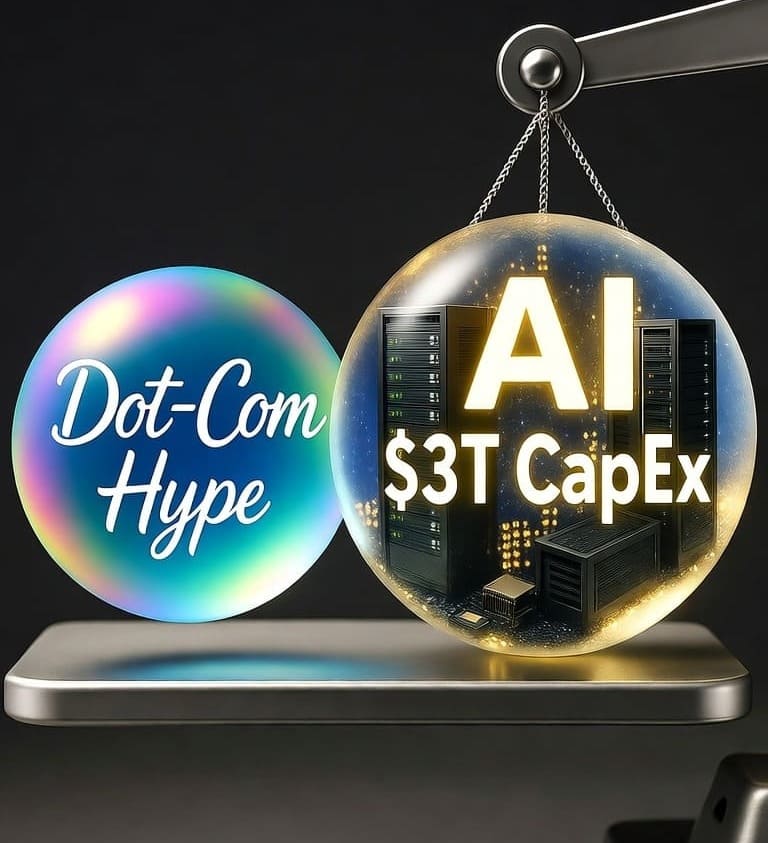

The whispers are growing louder. Indeed, every week brings massive valuations. We see a $500 billion private company, a $4.5 trillion chipmaker, and a total market value larger than entire G7 economies. We are clearly in an Artificial Intelligence bubble. The real question is how high it will float before gravity claims its prize.

Comparing this moment to the 1999 Dot-Com crash is too easy. Dot-Com companies had zero revenue. They built on almost free infrastructure. Conversely, the AI boom is the opposite. It follows a far scarier math problem. It demands trillions of dollars of guaranteed, upfront capital spending (CapEx). This CapEx pays for hardware, power, and data centers. Future, guaranteed, and highly profitable utility must justify these huge costs.
Therefore, this is the Trillion-Dollar Utility Debt. This debt is the gap between the massive capital we must spend today and the measurable economic value we are certain to extract tomorrow. The AI bubble is more than just hopeful investing. Rather, it is a fundamental problem of capital physics. The cost to build the infrastructure is growing faster than the proven profit from the application layer.
The Capital Physics Problem: CapEx vs. Proven ROI
The core difference between the AI frenzy and past tech bubbles is how money is invested.
In the Dot-Com era, a cheap office and a server were enough to launch a $1 billion company. Infrastructure cost was small compared to the potential payoff. However, today, AI requires building digital power plants.
- The Cost Cliff: Training and running an advanced Large Language Model (LLM) involves an exponential cost function. Every update needs much more energy, chips, and cooling. In fact, global analysts estimate we may need to spend over $3 trillion on AI infrastructure by 2028. This total includes chips, data centers, and power grid upgrades. Consequently, this massive spending drives the skyrocketing valuations of companies like Nvidia, Oracle, and the major cloud providers. Analysts like Morgan Stanley cite potential requirements of $3 trillion in capital by 2028 for computing capacity.
- The Debt Creation: A cloud provider borrows billions to build a new AI data center. They bet their future on constant demand growth from software companies (like OpenAIs and Anthropics). Similarly, these software companies bet their future on enterprises always paying high prices for their services. This creates a chain of financial dependency: a utility debt. Ultimately, widespread, profitable adoption must repay this debt. Furthermore, if companies adopt AI slowly, the debt becomes toxic. This also happens if competition forces model providers to slash rates.
The Opacity Multiplier: The Black Box Dilemma
The second unique feature is the Opacity Multiplier. Specifically, modern AI economics are a black box. In past technologies, we could accurately calculate the marginal cost. We cannot do this now.
- Unknown Cost Structure: What is the exact cost to generate one token? The precise training and inference costs are secret and constantly changing. In turn, this opacity stops customers and investors from performing rational cost-benefit analysis.
- Uncertain Utility: Studies show a big gap between AI pilot projects and scaled-up, profitable deployment. Research from MIT and McKinsey suggests 80% to 95% of all AI pilot projects fail to deliver lasting value or reach the scaling phase. Often, this failure happens because they do not properly integrate into workflows or cannot overcome data quality hurdles.
- The Valuation Trap: The true value (and revenue potential) is unclear. It is unproven at scale. For this reason, investors must value the technology based on its potential for disruption. They cannot use current, measurable profit to value it. This lack of clear, tangible ROI creates a vacuum filled entirely by hype. In effect, this makes the entire ecosystem vulnerable. A sharp correction will happen when scaling costs meet slow enterprise adoption. Even tech leaders like Jeff Bezos and Sam Altman acknowledge the “overexcitement” and possibility of a bubble. This bubble is driven by massive investment cycles.
The Motivational Pivot: How to Survive the Capital Shock
The fear of the Trillion-Dollar Utility Debt is real. Nevertheless, it presents a massive strategic opportunity. The AI ecosystem’s foundation suffers from dangerous over-capitalization. Therefore, the path to survival is simple: shift focus from the Base Layer to the Application Layer.
1. Abandon the LLM Land Grab: Stop trying to build a better foundational model (unless you have a country’s GDP). The few companies controlling the capital and the chips have won that race. The coming correction will wipe out most mid-tier model providers.
2. Focus on the Moat of Workflow: The model itself does not create true, defensible value. Instead, value comes from how skillfully the integration embeds the model into the specific, painful workflows of a niche industry. Crucially, the Moat is in the integration, not the algorithm.
- Example: Don’t build a general LLM for law. Instead, build a small, specialized AI agent. This agent integrates with a mid-sized law firm’s existing document management system. It can automatically process litigation hold notices—a task so painful they’ll pay any price to automate it.
3. Build on Small Data, Not Big Data: The hunger for Big Data incurs the Utility Debt. Profitable application-layer companies will thrive on high-quality, proprietary Small Data. This is the data their customers generate daily. This approach dramatically reduces inference costs. Furthermore, it also cuts down on the reliance on the $3 trillion infrastructure layer.
If the AI bubble pops, it won’t just be a retraction of investor enthusiasm. Indeed, it will be a painful, systemic repricing of the physical infrastructure needed to run a digital economy. Ultimately, the winners focused on real, measurable application-layer profitability from day one. They did not just join in the physics of capital destruction.
Frequently Asked Questions (FAQ)
Is this a “Bubble” or a “Boom”?
It is a fragile boom fueled by speculative, bubble-like behavior. The underlying technology (AI) is genuinely transformative; thus, this suggests a “boom.” On the other hand, scaling requires extreme, centralized, and non-linear capital expenditure. This is especially true for companies with unclear revenue streams. Consequently, this creates unsustainable asset valuations, which are like a bubble at the infrastructure layer.
What is the most critical risk?
The most critical risk is the inevitable slowdown in data center construction and chip purchases. This will happen once the initial corporate FOMO (Fear of Missing Out) slows down. When infrastructure spending stalls, the primary revenue stream for the trillion-dollar companies (Nvidia, Cloud providers) slows sharply. This triggers a massive market correction that ripples across the entire tech sector.
How can a new investor approach this market?
Avoid highly generalized, capital-intensive AI platforms. Look for companies in the application layer that show high ROI on a small, specific set of data (a narrow focus). If a company can charge a premium for solving a known $10 problem using $1 of compute, the utility debt crisis does not affect that company.
Why is this different from the railroad or telecom bubbles?
The railroad and telecom bubbles involved over-building physical capacity (tracks, fiber). This capacity eventually became useful after a long, painful consolidation. However, the AI bubble involves over-building capacity that must be continuously and expensively upgraded. This is due to the exponential nature of LLM progress. The asset decays faster, making the financial shock potentially more immediate and severe.
External Sources Referenced:
- AI Cost Estimates: Morgan Stanley analysis citing potential requirement of $3 trillion in capital by 2028 for computing capacity. Source Link
- AI Pilot Failure Rates: MIT and McKinsey studies highlighting that a significant majority of Generative AI pilot projects fail to scale or deliver sustainable value in enterprise settings. Source Link
- Venture Capital Concern: Investor comments (e.g., Jeff Bezos, Sam Altman) acknowledging the “overexcitement” and possibility of a bubble driven by massive investment cycles. Source Link
AI Bubble, Utility Debt, Capital Physics, CapEx, ROI, Application Layer, Black Box Dilemma, Exponential Cost