


The Silent Tax: Why Your Smallest Choices Are Ruining Your Focus
You pay a hidden fee every single day: the Small Decision Tax. For example, every time you choose a color, pick a lunch spot, or write a quick email, you drain your mental fuel. Scientists call this Decision Fatigue. Consequently, this energy drain leaves you exhausted when you finally sit down for important work.
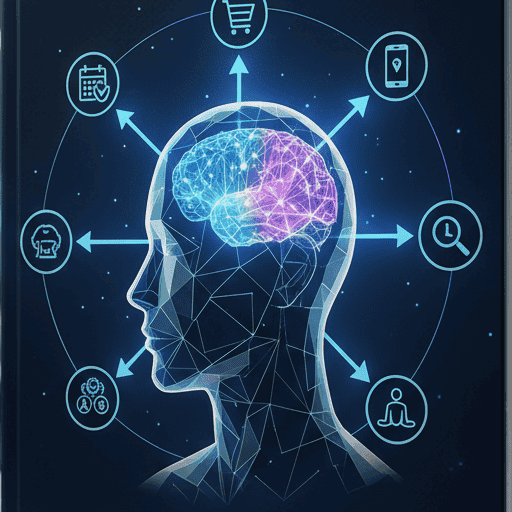
Therefore, the new purpose of AI is not to write content. Rather, it should serve as your Cognitive Offloader. Its main job is to automate repetitive, low-impact tasks. This effectively gives you back hours of Deep Focus. However, this isn’t about consumption. Instead, it’s The Attention Diet—a simple plan to automate 80% of choices that bring zero strategic return. To truly understand this cost, read this foundational study on The Science of Decision Fatigue and Ego Depletion.

Section 1: The 6 Daily Decisions That Consume Your Cognitive Fuel
To begin, here are the six common decisions that waste your focus. Therefore, these are the clear targets for your new AI system:
1. The Meal Monotony Dilemma
“What’s for dinner?” This daily question is a major cognitive sink. In fact, strategic decisions, on the other hand, require your full mental capacity.
2. The Information Flood Filter
Deciding which of the hundreds of notifications, Slack messages, or news headlines needs attention right now. In essence, this constant sorting keeps your brain in a state of high alert.
3. The Social Grace Redirect
Writing polite, routine replies to vague, semi-formal emails or texts. Specifically, these low-stakes interactions waste valuable creative time.
4. The Optimal Commute/Errand Route
Manually checking traffic, construction, or weather to pick the best route. Therefore, letting AI handle this dynamic analysis saves your conscious thought.
5. The Energy and Schedule Audit
Deciding when to rest or stop working based on how tired you feel. Instead, AI can analyze your sleep and work metrics to schedule your optimal stop time.
6. Small, Repeated Procurement
The loop of re-ordering coffee, paper, or basic kitchen supplies when you run out. Consequently, automating this small task frees up memory space.
Section 2: Building Your Personal Cognitive Offloader
To achieve this freedom, you must change your mindset. Don’t just ask the AI; actively force it to maintain your boundaries. Specifically, here are three practical AI Blueprints (using system prompts) to automate the most tiring decisions:
Blueprint 1: The ‘Five-Week Cycle’ Meal Planner (Automating Monotony)
This technique ensures you never decide on food again. Simultaneously, you add variance by rotating meal plans, thereby ending the feeling of repetition.
- Prompt Example: Act as a strict, non-negotiable meal planner. Your goal is to create five weeks of rotating, fixed weekly menus. The constraints are: $$ No carbs after 6 PM,Must include one vegetarian day,Weekly grocery budget max $150.∗∗Output:∗∗Week1menu(Monday−Sunday)withsimple5−stepinstructions.
Blueprint 2: The ‘Prioritization Score’ Filter (Automating Triage)
What’s more, this turns information consumption into a passive process. Consequently, the AI becomes your Chief of Staff for incoming data. To implement this effectively, you can feed the AI a digest of your inbox or feed:
- Prompt Example: Act as my Focus Guardian. Analyze the 50 summarized news headlines I provide. Score each headline from 1 (Vital) to 10 (Trivial). The only Vital criteria are: $$ Market movements affecting sector XandDirectly requested client data.∗∗Subsequently∗∗,returnonlythe5′Vital′headlines,summarizingeachinonesentence.
Blueprint 3: The ‘Automated Replenisher’ Agent (Automating Procurement)
Crucially, this blueprint connects low inventory levels to action without you intervening. Ultimately, it eliminates the annoying need to remember to reorder. It is important to note, however, that you must wait 7 days between any two automatic orders.
- Prompt Example: Act as my Supply Chain Manager. Based on the inventory checklist I give you (coffee, milk, printer paper), if any item is flagged ‘RED,’ generate the exact one-click order link from Amazon Fresh/Staples. However, you must wait 7 days between any two automatic orders.
Section 3: The Payoff: Reclaiming 4 Hours of Deep Focus
To conclude, the biggest return on your AI investment is not financial. Instead, it’s purely cognitive. Indeed, reclaiming those hours means you unlock Cognitive Freedom. Therefore, this is the highest form of modern luxury.
- The Difference: The saved mental energy doesn’t mean 4 more hours of work. Rather, it means 4 hours of True Deep Work—the type of thinking reserved for strategy, long-term planning, and breakthrough creativity.
- For example, by offloading meal planning, your brain isn’t worrying about small logistics. Instead, it’s free to solve the major problem in your career.
- To see the power of automated decisions on brain function, review this resource on The Impact of Routine on Executive Function.
The choice is now simple: continue exhausting your brain on trivial details, or alternatively, adopt the Attention Diet and dedicate your mind to what truly matters.
Which of the six attention-draining decisions will you delegate to AI first?
AI Productivity, Decision Fatigue, Deep Focus, Prompt Engineering, Cognitive Offloading, Time Management, Attention Diet


